Contents
Understanding Tokyo: why is the city so spread out?
European cities usually grow around a square. Tokyo grew around railway stations. The loop line called the Yamanote circles the heart of the city like a ring, and every major station on that ring — Shinjuku, Shibuya, Ueno, Tokyo — behaves like a city centre in its own right, with its own skyscrapers, its own underground shopping streets and its own drinking alleys.
That's why there's no honest answer to "where is the centre of Tokyo?". If you build your trip not around covering the whole city but around really seeing one or two neighbourhoods a day, you'll get less tired and see more. Getting from one end of the Yamanote line to the other takes half an hour; a plan aiming for three neighbourhoods a day means spending a large part of the day on a train.
Another unusual detail: most streets in Tokyo have no name. Addresses are made up of the district, block and building number. Even locals look at a map when going somewhere; you will too, and there's nothing embarrassing about it.
Things to see: Tokyo neighbourhood by neighbourhood
The neighbourhoods below genuinely have different characters. Rather than squeezing them all into one day, group them in pairs; combining those that are geographically close makes the day easier.
Asakusa and Ueno — where the old city survives
Senso-ji is the city's oldest temple. Nakamise Street, which runs from the main gate to the temple, is packed during the day; go at seven in the morning and the same street is almost empty and the temple looks like a completely different place. This is where getting up early in Tokyo pays off most.
Ueno Park is right next door, with the Tokyo National Museum and several other museums inside. If you're going to give a day to Japanese art history, give it here. The Ameyoko market south of the park is a narrow, noisy street left over from the post-war black market — everything from dried fruit to seafood is sold here, and in the late afternoon stand-up drinking shops open.
Shibuya and Shinjuku — the aesthetics of the crowd
The Shibuya crossing is smaller than you expect but more impressive than you expect. You don't need paid observation decks to see it from above; you can also watch from the upper floors of surrounding shops or from the station's overpass.
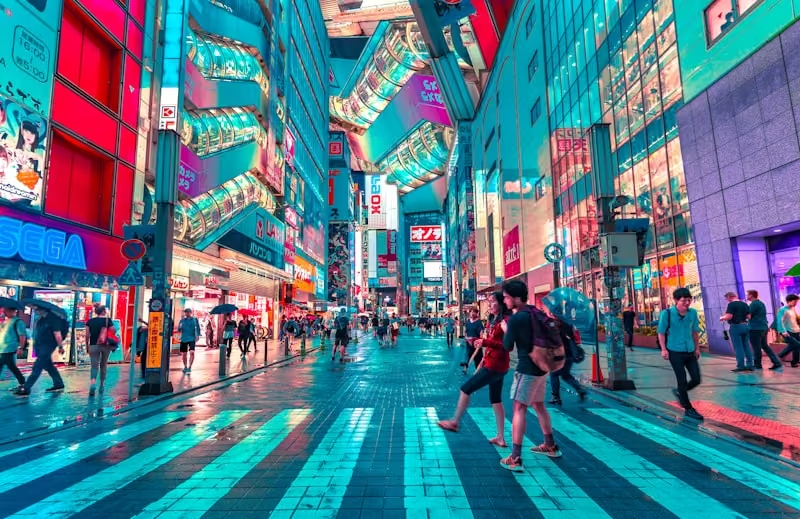
Shinjuku splits in two. The west side is skyscrapers and hotels; the observation floor of the Tokyo Metropolitan Government Building has been free for years, and on a clear day you can see Fuji. The east side is the neon of Kabukicho and the narrow lanes of Omoide Yokocho: passages two or three metres wide, six-seat grill bars, soot and smoke. Tokyo's most photogenic evening hours are here.
Yanaka, Shimokitazawa, Kiyosumi — the side few tourists see
Yanaka is one of the rare neighbourhoods that largely escaped wartime destruction: low wooden houses, cherry trees lining a cemetery, a small shopping street full of cat figures. You can walk it in half a day, and it's restful after the noise of the city.
Shimokitazawa is the neighbourhood of second-hand clothes and small record shops; with its theatres and cafés it has a student energy. Kiyosumi-Shirakawa, meanwhile, is the Tokyo base of third-wave coffee — old warehouses have become roasteries. If you're into coffee, give this neighbourhood a morning.
What to eat? An introduction to Tokyo food
It's genuinely hard to eat badly in Tokyo. The city's strength comes less from its starred restaurants than from small shops that have done one thing for decades. A seven-seat ramen counter, a family business that makes only tempura, a soba stand under a station — that's where real Tokyo food is.
Don't miss: sushi (especially in the morning, around the market), ramen (every neighbourhood has its own style), tempura, tonkatsu, soba and unagi. Street-food culture isn't as strong as in Osaka; in Tokyo, food is mostly eaten sitting down, quietly and quickly.
Two practical notes: there's no tipping in Japan, and trying to leave a tip will be politely refused. Many small places have a ticket machine at the door — you buy your ticket first, then sit at the counter.
Fish markets: Tsukiji or Toyosu?
These two get confused because of a split in 2018. The wholesale market and the famous tuna auction moved to Toyosu. But the Tsukiji Outer Market, where travellers actually go, didn't close; it carries on with many shops and restaurants.
The practical distinction is this: if you're going to eat and look around, go to the Tsukiji Outer Market. It's morning-focused, but every business has different days and hours; don't rely on a single opening and closing rule. If you want to watch the tuna auction, you need to go to Toyosu: under the current official arrangement the auction takes place roughly 05:30–06:30, the upper visitor corridor can be seen without a reservation, and the lower observation area closer to the glass is limited in numbers and allocated by lottery in advance.
Honest advice: unless you're curious enough to get up at four in the morning, the auction can be skipped. A bowl of seafood eaten in the outer market at half past eight gives most travellers a better morning.
Where to stay? A guide to choosing a neighbourhood
In Tokyo, a hotel's distance from the station matters more than its star rating. The difference between "5 minutes' walk" and "12 minutes' walk" is felt twice a day, with luggage, in the heat.
Shinjuku — the most lines, the most options, lively even late at night. The safest choice for first-timers. The trade-off: it's noisy.
Tokyo Station / Marunouchi — mostly business hotels, quiet, with very easy Narita and Shinkansen connections. Weak evening life.
Asakusa — more affordable, traditional character, ideal for morning sightseeing. Its distance from the central lines is its only weakness.
Shibuya — young and lively, with shopping and food within walking distance. Prices are high.
Ueno — one of the best neighbourhoods for balancing price and location; it has a direct connection to Narita, and the park and market are within walking distance.
How to get to Tokyo: from the airport to the city
Haneda (HND) is much closer to the city; by monorail or the Keikyu line you reach the centre in around half an hour. If Haneda is among your flight options, factor in this difference before choosing Narita, even if Narita is somewhat cheaper.
Narita (NRT) is far from the city; the connection to the centre takes about an hour by express train and longer by bus, depending on traffic. On flights landing late at night, check the last train time in advance — if you miss it, a taxi fare in Japan is a serious sum.
Getting an IC card (Suica or Pasmo) when you arrive makes things easier. Where physical visitor cards are sold may change; a digital card on a compatible phone is also an option. It works on the metro, JR, buses and in convenience stores, so you don't have to buy a ticket every time you board.
Getting around: cracking the metro
Tokyo doesn't have a single metro company. Tokyo Metro, Toei and JR are separate operators; the same station name may correspond to different places on different companies' networks. An IC card largely solves this complexity, because you don't have to think about whose line you're boarding.
Pay attention to exit numbers at big stations. Shinjuku has dozens of exits, and coming out of the wrong one can leave you ten minutes from where you're going. Noting the exit number next to your destination in advance is the first local habit you learn in Tokyo.
The last trains leave around midnight; after that the city doesn't go quiet, but getting around gets expensive. If you're going to be late, either work out the last train or plan to be somewhere open until the first train in the morning — Tokyo isn't the only city where people do this, but it's one of the most comfortable.
When to go?
Spring (late March–May) is the most popular period. Cherry blossoms usually fall between late March and early April, but the date changes every year and is squeezed into a one-week window; buying tickets around it is risky.
Autumn (October–November) is, in my view, the better option: balanced weather, low humidity, fewer crowds, and in late November maple colours come down into the city's parks.
Summer (June–August) is hot and very humid; June is the rainy season. Sightseeing on foot in August is genuinely tiring. Winter, on the other hand, is clear and dry, crowds thin out and your chances of seeing Fuji go up — and prices are lower.
Budget: is Tokyo really expensive?
The idea that Tokyo is expensive is somewhat out of date. Accommodation and taxis are expensive, but food is surprisingly reasonable: a filling meal in a small eatery usually costs less than in the big cities of Western Europe.
Three items strain your budget: hotels, long-distance trains and museum/tower admissions. Invest in the first (location really matters) and be selective with the other two. The city has plenty of free viewpoints.
Local tips and common mistakes
Carry cash. Card use has spread, but small eateries, temple entrances and some market shops still take cash only.
Don't talk on the phone on the metro. Silence is a rule of courtesy here; being the only person talking in the carriage gets noticed.
Finish your food where the business indicates, without littering. In some markets and sacred sites, eating while walking is clearly unwelcome; follow local signs and carry your packaging back with you.
Don't over-plan. The best moments in Tokyo are usually unplanned: the street you find after taking the wrong exit, the bar you walk into through a door whose name you can't read.
You can send your luggage ahead. Forwarding a suitcase from hotel to hotel between cities is a common service; confirming the delivery time and acceptance conditions with the hotel makes the train journey noticeably easier.
Where to eat: selected places
These aren't places to tick off one by one — they're the stops that best capture how the city eats. Opening hours and prices change, so check before you go.
Tsukiji Outer Market
Mid-rangeTsukiji · Seafood stalls and breakfast
Not a single restaurant but a whole street of options. Wandering from stall to stall at nine in the morning, tasting tamago, sea urchin, grilled fish and fresh oysters as you go, is Tokyo's most enjoyable breakfast.
Go in the morning; every shop has different opening days and hours. Don't rely on a single market calendar.
Shinjuku Tsunahachi
Mid-rangeShinjuku · Tempura since the 1920s
A reliable classic for experiencing tempura not as a heavy, greasy mixed plate but as a meal where ingredients are fried in turn and served hot. The main Shinjuku shop is an accessible introduction to this city tradition.
Don't confuse the main shop with other branches; check the current queue and reservation arrangements on the official site.
Kanda Matsuya
Mid-rangeKanda–Awajicho · Soba in a historic wooden building
You go to understand the texture of soba noodles and the dashi-based sauce in their simplest form. It's not a showy tasting; it's a living example of Tokyo's old single-focus tradesmen's eateries.
Consider an early or late meal instead of the busy lunch hours; confirm opening days through the official channel.
Maisen Aoyama Honten
Mid-rangeJingumae–Omotesando · Tonkatsu in a characterful former bathhouse hall
A good starting point for seeing the balance of crisp coating and tender pork in a classic tonkatsu setting. The converted former bathhouse section of the main shop offers a more characterful experience than the chain branches.
The cut and weight of meat vary between sets; if it's your first time, ask staff to help you choose fattier or leaner.
Tsujihan Nihonbashi
Mid-rangeNihonbashi · A rich seafood bowl with a second serving in dashi
Eating the kaisen-don-style bowl as it is first, then a few reserved mouthfuls with hot dashi, gives two different textures. Good for anyone who wants a strong seafood-focused meal without getting up for the Toyosu auction.
The queue at the small main shop can get long; checking the business's current branches can save time.
Sometaro
Mid-rangeNishi-Asakusa · Okonomiyaki in an old-house atmosphere
Okonomiyaki cooked on the tabletop griddle while you sit on tatami shows Tokyo's more casual, hands-on side of eating. It's a characterful, non-chain lunch break after a morning in Asakusa.
The smell of the griddle gets into your clothes; check the small venue's current opening arrangements before you go.
Dietary preferences
Vegan and halal restaurants in Tokyo
For Tokyo we picked one plant-based place and one aimed at Muslim travellers. Halal labels don't all mean the same thing: certification, the restaurant's own declaration and "some halal options" are shown separately on each card.
Vegan Pick
Fully veganSaido
Jiyugaoka · Creative Japanese cuisine
A calm restaurant that reinterprets seasonal Japanese dishes entirely plant-based.
Why we picked it: One of Tokyo's strongest special-but-relaxed choices for anyone who wants the feel of sushi and kaiseki without animal products.
Verification note
The venue's plant-based coverage was checked in the directory; reconfirm the menu and opening days before booking.
Source: HappyCow's current vegan restaurant directory ↗Halal Pick
Restaurant-declaredPANGA
Taito / Okachimachi · Yakiniku and wagyu
A family business offering halal wagyu and tabletop grilling aimed at Muslim travellers.
Why we picked it: It offers a halal yakiniku experience, hard to find in Japan, in a central location.
Verification note
The business declares that it uses halal meat; ask about the current certificate, sauce ingredients and alcohol service before ordering.
Source: JNTO resources for Muslim travellers ↗Menus, suppliers and certifications change. If you keep strict halal, confirm the current certificate, alcohol, sauce ingredients and shared-kitchen risk directly with the restaurant.
Day-by-day itinerary
- 01
Day 1 — Old Tokyo
- Morning
- Go to Senso-ji at opening time and walk Nakamise Street without the crowds. Then breakfast in the back streets of Asakusa.
- Afternoon
- Ueno Park and the Tokyo National Museum. If the museum feels tiring, walk through the park and cross to Yanaka; explore before the neighbourhood shops close.
- Evening
- Head down to Ameyoko to see the market and the evening bustle under the tracks; close the day with a simple dinner around Ueno.
- 02
Day 2 — Modern Tokyo
- Morning
- Late breakfast at the Tsukiji Outer Market. Move from stall to stall; don't fill up in one place.
- Afternoon
- Shibuya: the crossing, the record and stationery shops in the back streets, then a short train ride to Shimokitazawa.
- Evening
- Shinjuku. First the free observation floor of the Metropolitan Government Building, then dinner in Omoide Yokocho.
- 03
Day 3 — Slow Tokyo
- Morning
- Coffee in Kiyosumi-Shirakawa and the Kiyosumi Teien garden.
- Afternoon
- Pick one neighbourhood and go deep: Nakameguro for architecture, Jimbocho for books, Akihabara for electronics and subculture.
- Evening
- See the city from above, then a simple dinner in a small eatery near your hotel.
Continue your Japan route
This city works well on its own; if you have time, the stops below add a different region and city to the same trip.
From Tokyo to Kyoto: from modern rhythm to the old capital
The natural next stop by Shinkansen; plan Kyoto by neighbourhood and time of day to manage the crowds.
Read the guide →From Tokyo to Sapporo: a separate Hokkaido leg
Fly north; the winter climate, soup curry and Hokkaido seafood open up a completely different layer of Japan.
Read the guide →Frequently asked questions
How many days do you need for Tokyo?+
You need at least 4 full days to understand the city's character. 3 days is enough for the main neighbourhoods but feels rushed. With 5 days you can also fit in a day trip such as Nikko or Kamakura.
Is the Tokyo metro confusing, and can I use it on my own?+
It feels confusing on the first day; by the second you'll be used to it. As different companies operate on the same network, getting an IC card (Suica or Pasmo) is the most practical solution. Station signs are in English and lines are coded by colour and number.
Has Tsukiji closed?+
No. In 2018 the wholesale market and tuna auction moved to Toyosu, but the Tsukiji Outer Market that travellers visit carries on with many independent shops and restaurants. Each business has its own days and hours.
Can you get by in English in Tokyo?+
On transport and in big venues, yes. It may be limited in small eateries, but menus mostly have photos and pointing works fine. Learning a few words of Japanese more than pays off.
Is Tokyo an expensive city?+
Accommodation and taxis are expensive, but food is cheaper than expected. A filling meal in a small eatery costs less than in many Western European capitals. Hotels and intercity train tickets put the most pressure on your budget.
Do people tip in Japan?+
No. There's no tipping culture, and money left on the table will be politely returned. Some places add a service charge to the bill.
How do you get to Tokyo?+
Haneda (HND) is much closer to the city; by monorail or the Keikyu line you reach the centre in around half an hour. If Haneda is among your flight options, factor in this difference before choosing Narita, even if Narita is somewhat cheaper.
Note: Opening hours, admission fees and whether venues are open change often. Before you set off, confirm the current status of the places you plan to visit. Last updated: .
Official sources and latest check
Visa, transport, entry and visiting rules change — re-check them with these official sources before you travel.